Security at Machine Speed

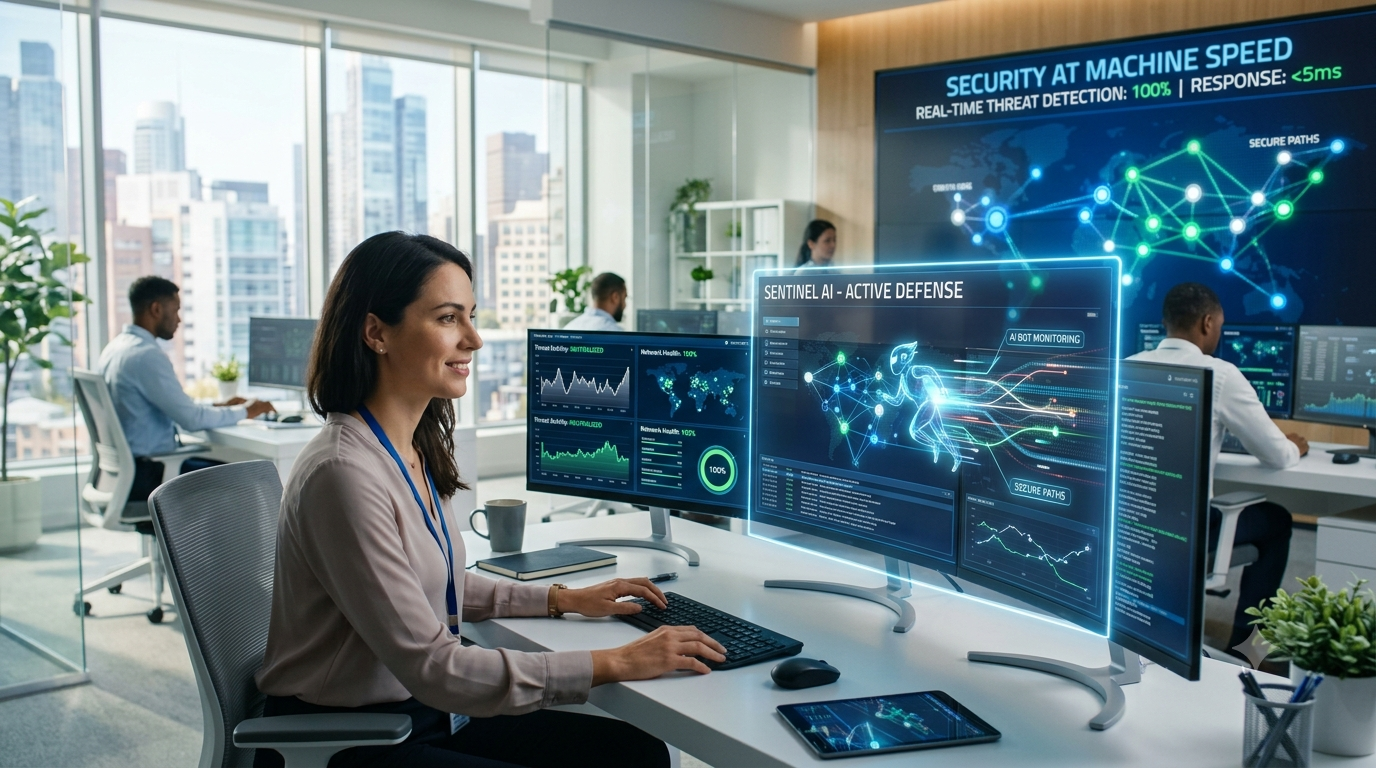
AI agents are starting to plan, act, use tools, iterate, and operate across digital environments at speeds no human can keep up with. A single agent can execute thousands of actions in the time it takes a person to read one email.
This creates a fundamental problem: just as we faced backlogs of code reviews, traditional human security reviews cannot scale to machine speed.
If every significant action an AI agent takes must be reviewed by a human, the system loses its advantages of speed and scale. The bottleneck moves from the agent to the human, and the entire value proposition collapses. We are approaching a point where requiring human sign-off on every step is not only inefficient it is impossible.
Yet one thing remains non-negotiable: ultimate responsibility and accountability must stay with humans.
We have faced this exact tension before. When closed-circuit television (CCTV) systems proliferated, no one expected a human to watch every camera feed in real time. Instead, we built layers of technology—motion detection, infrared sensors, facial recognition, automated alerts—that filtered the firehose of data down to the moments worth human attention. Humans still set the rules, defined what constituted a threat, reviewed critical incidents, and bore legal and operational responsibility. The technology amplified human oversight rather than replacing it.
We are now doing the same thing with AI, only the stakes and the speed are higher.
AI Securing AI
The frontier challenge is building systems that use AI to monitor, constrain, and correct other AI systems in real time. This includes:
- Behavioral monitoring and anomaly detection at the agent level — watching not just outputs but the sequence of plans, tool calls, and state changes.
- Automated policy enforcement — guardrails that are themselves learned or formally verified rather than simple string matching.
- Multi-agent oversight architectures — where one set of models continuously audits the actions and reasoning of operational agents.
- Scalable logging and reconstruction — so that when something goes wrong, humans can quickly understand why an agent took a particular path.
- Adversarial testing and red-teaming at machine speed — continuously probing agents for vulnerabilities faster than attackers can.
These are not science-fiction capabilities. They are active areas of work across frontier labs. The goal is defense-in-depth: no single layer needs to be perfect because multiple independent AI systems are watching each other, with humans defining the high-level objectives and escalation thresholds.
Humans Remain the Root of Authority
The architecture that works is not “AI replaces human judgment.” It is AI handles volume and speed; humans handle meaning, values, and final authority.
Humans will continue to:
- Define the constitution or policy set that agents must follow
- Set escalation criteria for high-stakes or ambiguous situations
- Review and approve major capability deployments
- Conduct post-incident analysis and update the rules
- Bear legal, regulatory, and moral accountability for outcomes
This is not a limitation to be overcome. It is the correct design. Technology changes the how of oversight; it does not change the who that ultimately owns the consequences.
The Practical Path
Organizations will have to treat it as a socio-technical governance problem:
- Build monitoring and control layers as deliberately as they build the agents themselves.
- Design clear escalation paths so that the most important decisions surface to humans quickly.
- Maintain human-understandable audit trails even when the underlying reasoning is complex.
- Continuously test the security stack against both external attackers and internal model drift or misalignment.
- Accept that perfect prevention is impossible and invest in fast detection and recovery.
We already proved this model works with physical and digital security infrastructure. CCTV did not eliminate the need for security personnel; it made them dramatically more effective. Infrared and sensor networks did not remove human responsibility; they extended human senses across time and space.
AI agents operating at machine speed require the same layered approach. Now the first layer of filtering and response must also run at machine speed. The technology to build that layer is advancing rapidly. The harder, more important work is designing the human governance structures that sit on top of it.
The organizations that use AI to secure AI while keeping humans firmly in the loop will be the ones that can actually deploy powerful agents safely at scale. Else, they will move too slowly to compete or move too fast and lose control.
Security at machine speed is not optional. It is the price of admission for the next era of automation.